The Ultimate Guide to Roof Replacement Cost in Illinois: Riverbend Homeowner Edition
For homeowners in Illinois, particularly within the Riverbend area, understanding the true cost of a roof replacement is the critical first step toward protecting your largest asset. This guide distills the current market trends, material selection consequences, and the lesser-known physical factors that determine your final estimate, helping you move past sticker shock toward an informed investment. You will gain clarity on the average cost per square for local projects, learn how variables like steepness and complexity inflate quotes, and discover which expensive components are often hidden until the tear-off begins. By mastering these elements, you are prepared to vet contractors rigorously and navigate insurance claims confidently, ensuring durability against Illinois’ severe weather patterns. Review the foundational pricing metrics now to build a budget that truly reflects quality and longevity.
Understanding Roof Replacement Costs in Illinois and Riverbend
Estimating a roof replacement cost in the Riverbend area—covering communities like Alton, Godfrey, and Edwardsville—isn’t as simple as picking a number out of a hat. Because Illinois experiences the full range of Midwest weather, from humid summers to ice-heavy winters, your roof works harder here than in many other parts of the country. Understanding the local market is the first step in planning your investment.
The Current State of the Illinois Roofing Market
Navigating the roofing landscape in Illinois requires an understanding of both local demand and broader industry trends. According to the National Roofing Contractors Association (NRCA), fluctuations in material availability and regional labor rates play a significant role in determining final estimates. In the Riverbend area specifically, we see a mix of historic homes that require specialized care and modern subdivisions where efficiency is the priority.
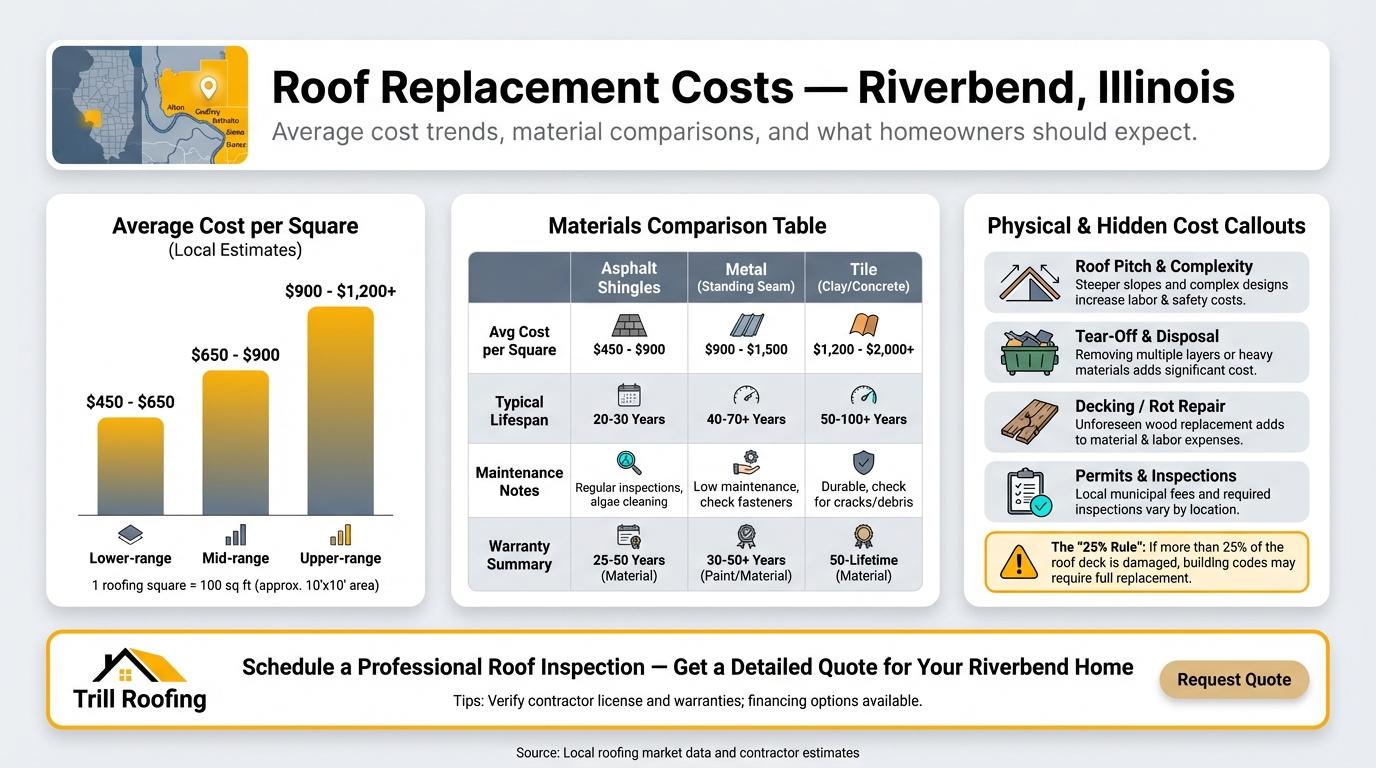
Beyond materials, Illinois homeowners must account for local building codes and permit fees, which vary by municipality. Factors like the “Ice and Water Shield” requirements—essential for our freeze-thaw cycles—are non-negotiable for a long-lasting roof in this region and will be reflected in your total project cost.
Defining the ‘Typical’ Project Scope
When we talk about a “standard” roof replacement, we are looking at a comprehensive process, not just a layer of new shingles. For most Riverbend residents, a typical project involves a home between 2,000 and 3,000 square feet, which translates to roughly 20 to 30 “squares” of roofing material.
A standard scope of work generally includes:
- Tear-off: Removing one or two existing layers of old shingles.
- Decking Inspection: Checking the wood beneath for rot or soft spots.
- Underlayment: Installing felt or synthetic barriers and ice/water shields.
- Flashing: Replacing metal around chimneys, vents, and valleys.
- Ventilation: Ensuring the attic breathes properly to prevent shingle bake.
- Cleanup and Disposal: Proper hauling of old debris and magnetic sweeping for nails.
Before we dive into the specific numbers and how they break down by material, it’s important to understand how these variables come together to form a professional estimate. For a deeper look at the step-by-step process of what happens during the job, check out our full roof replacement services guide.
What is the Average Cost per Square for a New Roof?
If you are trying to budget for a roof replacement cost, the first thing you need to understand is how contractors measure your home. Unlike interior flooring which is measured by the foot, roofing is calculated by the “square.”
Breaking Down the ‘Roofing Square’ Metric
A roofing square is a standard industry unit of measurement equal to 100 square feet (a 10′ x 10′ area). Contractors use this metric because it simplifies the math for large surface areas and helps determine exactly how many bundles of shingles or rolls of underlayment are required for the job.
When you receive an estimate, the price per square typically includes both materials and labor. In the Illinois Riverbend area, you can expect the cost per square to vary based on the height of your home, the steepness of the roof, and the specific materials being installed.
Estimating a 2,000 Sq Ft Home in Illinois
It is a common misconception that a 2,000 sq ft home requires exactly 20 squares of roofing. In reality, because of the roof pitch (slope), eaves, and overhangs, the actual surface area of the roof is usually 25% to 40% larger than the home’s square footage.
[insert chart of estimated roofing squares needed based on home square footage and pitch here]
For a standard 2,000 sq ft home in our region, these are the starting estimates you might see for a full replacement using different materials:
- [asphalt shingle roofing](https://www.trillroofing.com/asphalt-shingle-roofing/): These projects often see starting estimates ranging from $9,000 to $15,500 depending on the shingle quality and roof complexity.
- Architectural Shingles: These provide more durability and often fall into starting estimates of $11,000 to $18,000.
- Metal Roofing: For homeowners looking for longevity, metal options typically begin with starting estimates of $18,000 to $30,000+.
Keep in mind that these figures are starting estimates designed to give you a ballpark idea of the investment. Your final quote will depend on factors like the removal of old layers, the condition of the wood decking underneath, and any necessary flashing or ventilation upgrades.
How Roofing Materials Influence Your Total Estimate
When you start looking at your roof replacement cost, the material you choose is the single biggest factor in the final price tag. While budget-friendly options like asphalt are the standard for many homeowners, premium materials like metal or tile offer long-term durability that can change the math on your investment over time.
Asphalt Shingles vs. Metal vs. Tile
Most homeowners in the Riverbend area opt for asphalt shingle roofing because it offers the best balance of upfront affordability and reliable protection. However, if you are planning to stay in your home for decades, investing in metal or tile might actually lower your “cost per year” of ownership.
Here is how these common materials stack up against each other:
| Material Type | Average Cost per Square | Lifespan (Years) | Maintenance Level |
| :— | :— | :— | :— |
| Asphalt Shingles | $350 – $600 | 20 – 30 | Low |
| Metal Roofing | $800 – $1,500 | 40 – 70 | Very Low |
| Tile Roofing | $1,200 – $2,500 | 50 – 100 | Moderate |
[insert chart comparing long-term ROI of asphalt vs. metal roofing here]
Warranty Differences Between Materials
When evaluating your estimate, it is vital to distinguish between the two types of protection you’ll receive.
- Manufacturer Warranty: This covers the actual product—the shingles, metal panels, or tiles. If your materials fail due to a factory defect, the manufacturer is responsible for the replacement cost. Higher-end materials often come with longer-duration manufacturer warranties.
- Workmanship Warranty: This is provided by the contractor and covers the installation process. At Trill Roofing, we emphasize this because even the best materials will fail if they aren’t installed correctly. This warranty protects you against leaks or issues caused by errors during the roof replacement process.
Material Performance in the Illinois Climate
In the Illinois Riverbend area, our roofs face everything from heavy snow and ice dams to high-velocity winds and summer humidity.
- Asphalt Shingles: These are engineered to handle the thermal expansion and contraction common in our climate. Modern architectural shingles also provide excellent wind resistance for those flat-land gusts.
- Metal Roofing: Highly effective at shedding heavy snow loads quickly, which prevents ice damming. It is also incredibly resistant to hail damage, which can be a major factor in local insurance claims.
- Tile Roofing: While beautiful and incredibly long-lasting, tile requires a reinforced roof structure to handle the weight, especially when you add the weight of winter snow.
Choosing the right material for your residential roofing project isn’t just about the initial price; it’s about how that material will stand up to the local weather over the next several decades.
Physical Factors That Drive Up Your Roofing Quote
Not every roof is a simple rectangle. The shape, height, and slope of your home play a massive role in determining your final roof replacement cost. Understanding these physical variables can help you see why two homes of the same size might have very different estimates.
The Impact of Roof Pitch and Complexity
The “pitch” or steepness of your roof is a primary cost driver. A steep roof is more dangerous and difficult to walk on, requiring specialized safety equipment and significantly more time to navigate. Most contractors charge a “steep charge” for any roof that exceeds a 6/12 pitch.
[insert diagram showing different roof pitches and complexity levels here]
Complexity also matters. A roof with multiple “hips” and “valleys”—the spots where two roof planes meet—requires more precise cutting and additional materials like high-quality flashing. If your home has a unique layout, expect the labor costs to reflect the extra attention needed to ensure a watertight seal.
Labor Requirements and Accessibility
How easily a crew can access your roof impacts the total labor hours. If your home is surrounded by dense landscaping, fences, or sits very close to a neighbor’s property, it takes longer to set up ladders and move materials safely. When a roof replacement team can’t park their truck right next to the house, the extra time spent hauling shingles adds up.
Height is another major factor. A two-story or three-story home requires more staging and rigorous safety protocols than a single-story ranch. Additionally, certain architectural details require extra labor to flash and shingle around properly, including:
- Dormers
- Chimneys
- Skylights
- Vent pipes
If you are currently dealing with leaks specifically around these features, you might only need targeted roof repairs. However, during a full installation of asphalt shingle roofing, these areas must be meticulously waterproofed to prevent future damage to your home’s structure.
Identifying the Most Expensive Components and Hidden Costs
When you receive a quote for a roof replacement cost, the total number can feel overwhelming. To understand where your money is going, it is helpful to break down the specific components that drive the price up and the “hidden” issues that only surface once the work begins.
The Most Expensive Part of Replacing a Roof
For most Illinois homeowners, the single biggest expense in a roof replacement isn’t actually the shingles—it’s the labor. Roofing is a physically demanding, high-risk trade that requires specialized skills and insurance. Roughly 60% to 70% of your total estimate typically goes toward the crew’s time and expertise.
The remaining cost is tied to materials. High-quality asphalt shingles and underlayment are significant investments, but choosing premium materials often leads to better long-term value by extending the life of your home’s primary defense system.
Tear-Off and Disposal Fees
A common question we hear is whether a new roof can simply be installed over the old one. While possible in very specific scenarios, we almost always recommend a full tear-off. This involves removing every layer of old material down to the wooden deck.
Tear-off costs include:
- Labor hours to manually strip the old roof.
- Dumpster rental fees to haul away thousands of pounds of debris.
- Landfill disposal taxes, which vary across the Riverbend area.
[insert graphic showing a typical cost breakdown: 65% labor, 35% materials]
What is the 25% Rule in Roofing?
If you are dealing with storm damage, you may hear your contractor or insurance adjuster mention the 25% Rule. This is a critical component of Illinois building codes (specifically the International Residential Code adopted by many local municipalities).
Under this rule, if more than 25% of a roof surface is damaged or needs to be repaired within a 12-month period, the entire roof section must be replaced to bring it up to current code. This ensures the structural integrity of the home and prevents homeowners from “patchworking” a roof that is no longer safe.
Common Hidden Costs in Illinois Roof Replacements
Even with a professional free inspection, some costs only become visible once the shingles are removed. Be sure to set aside a small contingency fund for these common surprises:
- Decking replacement: If the wooden boards (sheathing) underneath your shingles are rotted or water-damaged, they must be replaced before the new roof is installed.
- Flashing repair: The metal transition pieces around chimneys and dormers often need replacing to prevent future leaks.
- Disposal/Dumpster fees: Heavy loads or multiple layers of old shingles can increase the weight and cost of debris removal.
- Structural reinforcement: In older Illinois homes, we occasionally find sagging rafters that require extra support to handle the weight of new materials.
[insert checklist for homeowners: “How to prepare for hidden roofing costs”]
Navigating Insurance Claims: What Not to Say to Your Adjuster
When you are facing a potential roof replacement cost that totals thousands of dollars, an insurance claim can be a financial lifesaver. However, the outcome of your claim often hinges on the conversation you have with the insurance adjuster. While they may be friendly, their job is to evaluate the damage through the lens of your policy’s specific coverage limits and exclusions.
Protecting Your Claim During an Inspection
The best way to protect your interests during an inspection is to be prepared and observant. You aren’t required to climb the ladder with the adjuster, but you should be present to answer questions accurately.
One of the most effective strategies is to have a trusted local roofing contractor present during the adjuster’s visit. A professional roofer from Trill Roofing can point out specific areas of storm damage that an adjuster might overlook, ensuring the scope of work is comprehensive. This “second set of eyes” helps ensure that the estimate for your roof replacement cost reflects the actual damage rather than a minimized version.
[insert checklist graphic: Tips for a Successful Insurance Inspection]
Common Pitfalls: What NOT to Say to an Adjuster
The words you use can unintentionally give an insurance company a reason to deny or underpay your claim. To keep your claim on track, avoid using these specific phrases:
- “It’s just normal wear and tear.” This is perhaps the most dangerous phrase you can use. Insurance policies are designed to cover “sudden and accidental” damage, like hail or wind. If you characterize the damage as normal wear and tear, the adjuster may categorize it as a maintenance issue, which is almost never covered.
- “I think the leak has been there for a while.” Admitting to a long-term issue suggests neglect or lack of maintenance. Insurance companies expect homeowners to mitigate damage as soon as it occurs. If they believe you allowed a small leak to persist, they may deny coverage for the resulting structural or interior damage.
- “I’m not really sure when the damage happened.” A successful claim requires a specific Date of Loss. This allows the adjuster to verify weather reports for that day. Being vague can lead to the claim being flagged or denied due to a lack of evidence of a specific storm event.
- “It doesn’t look that bad from the ground.” Never minimize the damage. Many types of hail damage are invisible from the ground but compromise the integrity of the shingles. Let the professional inspection determine the extent of the impact.
- “I’ll just take the cheapest estimate.” While you might think you are helping the insurance company save money, you are actually lowering the “replacement cost value” of your claim. This could result in a payout that doesn’t cover a high-quality installation, leaving you with a subpar roof that won’t last.
By staying professional and sticking to the facts of the storm event, you can ensure that the process of calculating your roof replacement cost through insurance is fair and accurate. If you are unsure how to navigate this, we recommend reviewing our guide on storm damage roof repair to understand what adjusters are looking for.
Questions to Ask Before Signing a Roofing Estimate
Before you put pen to paper, you need to be certain that the company you’re hiring is qualified, protected, and transparent about their pricing. A low-ball estimate often hides missing credentials or a lack of proper insurance, which can leave you liable for accidents on your property.
Essential Contractor Vetting
In the state of Illinois, roofing is a regulated profession. This means any contractor you hire must hold a valid state license to perform the work legally. Before agreeing to a roof replacement cost, you should always verify your contractor’s license via the [IDFPR](https://online-dfpr.micropact.com/lookup/licenselookup.aspx) (Illinois Department of Financial and Professional Regulation).
Beyond licensing, ask these vetting questions:
- Do you carry both General Liability and Workers’ Compensation insurance? Request a certificate of insurance (COI) sent directly from their provider.
- Are you a local contractor? Ensure they have a physical office in the Riverbend area or nearby to handle any future warranty issues.
- Can you provide recent local references? A reputable roofer should be able to point to homes they’ve completed in your neighborhood.
Analyzing the Detailed Estimate
A professional estimate should be much more than a single number on a piece of paper. It should be a comprehensive breakdown of every component involved in your project. If an estimate is vague, it leaves the door open for “hidden costs” later.
Look for the following details in your written quote:
- Scope of Work: Does it include the removal of the old roof (tear-off) or just a layer-over? (We always recommend a full tear-off for the best long-term results).
- Material Specifications: Does it list the specific brand and line of asphalt shingles, underlayment, and flashing being used?
- Rotten Decking Policy: How much does the contractor charge per sheet if they discover damaged plywood or roof decking once the old shingles are removed?
- Cleanup and Disposal: Is the cost of the dumpster rental and debris removal included, or is that an extra fee?
- Payment Terms: Never pay the full amount upfront. A standard practice involves a deposit to secure the start date, with the balance due upon completion.
[insert checklist graphic: 5 Red Flags to Watch for in a Roofing Estimate here]
Project Timeline and Financing Your Roof Replacement in Illinois
Replacing your roof is a major home improvement project that requires both time and financial planning. In the Riverbend area, we understand that homeowners want the job done quickly and professionally without breaking the bank.
How Long Will the Work Take?
One of the most common questions we hear is, “How long will I have a construction crew at my house?” For a standard single-family home in Illinois, the actual installation usually takes one to three days.
However, the total project duration depends on several factors:
- Weather Conditions: Illinois weather can be unpredictable. High winds or rain will naturally pause the residential roof replacement process to ensure the safety of the crew and the integrity of your home.
- Roof Size and Pitch: Larger or steeper roofs require more time for tear-off and installation.
- Material Availability: While asphalt shingles are usually in stock, specialty materials like slate or specific metal profiles may have longer lead times.
[insert infographic showing a typical 3-day roofing project timeline from prep to cleanup]
Financing Your Investment
Because a new roof is a significant investment in your home’s value and safety, you shouldn’t feel pressured to pay the entire roof replacement cost upfront if it doesn’t fit your current budget. There are several ways to make the project more manageable:
- Roofing Company Financing: Many local contractors offer specialized financing plans with low monthly payments or deferred interest options.
- Homeowners Insurance: If your roof replacement is the result of “peril” (like the hail or wind storms common in the Metro East area), your insurance policy may cover a significant portion of the cost.
- Home Equity Line of Credit (HELOC): This allows you to borrow against the equity in your home, often at a lower interest rate than a personal loan.
- Personal Loans: Traditional bank loans can provide the necessary capital quickly for emergency replacements.
- Cash or Credit Cards: For those looking to avoid interest or earn travel rewards, most contractors accept standard payment methods.
By choosing the right financing path, you can ensure your home stays protected without causing a financial strain.
Protecting Your Investment in the Illinois Market
Investing in a new roof is about more than just aesthetics; in the Riverbend area, it is a critical line of defense. Illinois weather is notoriously unpredictable, swinging from humid summers with violent thunderstorms to winters defined by heavy snow loads and ice damming.
Why Riverbend Homeowners Prioritize Durability
When looking at your overall roof replacement cost, it is essential to consider the long-term ROI of high-performance materials. Our region frequently experiences high-velocity winds and damaging hail that can shred standard shingles in a single season. By choosing impact-resistant asphalt shingles or reinforced underlayment, you aren’t just spending more—you are buying insurance against the next “hundred-year storm” that seems to happen every few years in Madison and Jersey counties.
A cheaper roof might save you a few thousand dollars today, but if it fails during a February blizzard or a spring microburst, those savings vanish instantly into interior water damage repairs. At Trill Roofing, we often see how “budget” installations fail to stand up to Riverbend storm damage, leading to premature leaks. Understanding how these local environmental factors influence pricing is the first step toward making a smart investment that lasts 25 to 50 years.
[insert image comparing standard shingles vs. impact-resistant shingles after a hail storm]
To get a better handle on how quality correlates with price in our local market, let’s look at the specific numbers you can expect to see on a professional estimate.
Illinois Roof Replacement FAQs
What is the average roof replacement cost in Illinois for a 2,000 sq ft home?
For a 2,000 square foot home in Illinois, homeowners typically pay between $8,500 and $16,000 for a standard asphalt shingle replacement. This figure fluctuates based on the roof pitch, the number of layers being removed, and the specific shingle quality selected. High end materials like metal or slate will significantly increase this baseline beyond the standard range.
What is the ‘25% rule’ in Illinois roofing?
The 25 percent rule is a regulatory standard used by many Illinois jurisdictions and insurance companies to determine when a full replacement is mandatory. If damage affects more than a quarter of the total roof surface within a 12 month period, local building codes often require the entire system to be replaced rather than simply repaired. This ensures the structural integrity and safety of the dwelling meet modern standards.
Does a standard roofing quote include the cost of tear-off and disposal?
A comprehensive roofing estimate from a reputable contractor almost always covers the removal of old materials and the associated dump fees. This process involves stripping the existing shingles down to the wooden decking to inspect for rot or structural damage. Homeowners should verify that these labor and logistics costs are explicitly itemized to avoid unexpected expenses during the project.
How long does it typically take to replace a residential roof in the Riverbend area?
Most residential roof replacements in the Riverbend region are completed within one to three days. While a simple ranch style home might be finished in a single day, larger properties with complex rooflines or multiple stories require additional time for safety and precision. Environmental factors like heavy rain or high winds can also extend the projected schedule.
What are the financing options available for homeowners needing a new roof?
Homeowners have several paths to fund a new roof, ranging from specialized contractor financing programs with low monthly payments to home equity lines of credit. Some residents also utilize personal loans or navigate the process through insurance claims if the replacement is due to storm damage. Choosing the right financial structure helps ensure the home remains protected without causing immediate financial strain. Professional guidance provides the necessary clarity to move forward with confidence.
Get Your Custom Roofing Quote
Finding the right balance between cost and quality starts with a thorough evaluation of your current system. You can easily begin this process by requesting a detailed estimate for comprehensive roof replacement services that address the unique architectural needs and weather challenges of your residence.